

How Artemis 2 Was Made: the AI film that passed 5 million views
TL;DR
CGEYE's Artemis 2 is a film about the NASA lunar mission, generated entirely with AI and finished with rigorous human editing. It One video passed 5 million views on Facebook and the series passed 2 million on Instagram, with 159,000 likes and more than 500 comments. Not through volume of generation, but through the curatorial discipline applied to every selected take. The discipline is in the discard.
Independent AI-generated creative work inspired by the NASA Artemis II mission. Not affiliated with, endorsed by, or produced in partnership with NASA or any government agency. All visuals were generated using artificial intelligence. No actual NASA footage was used.
Watch the full reel
All visuals are AI-generated. No actual NASA footage was used.
The creative concept
Artemis 2 is not a fictional mission. It is the next crewed lunar orbit from NASA, the first humans to approach the Moon in over 50 years. The historical weight was already there. The question was specific: how do you represent that moment without reaching for the sci-fi visual vocabulary Hollywood built over 60 years?
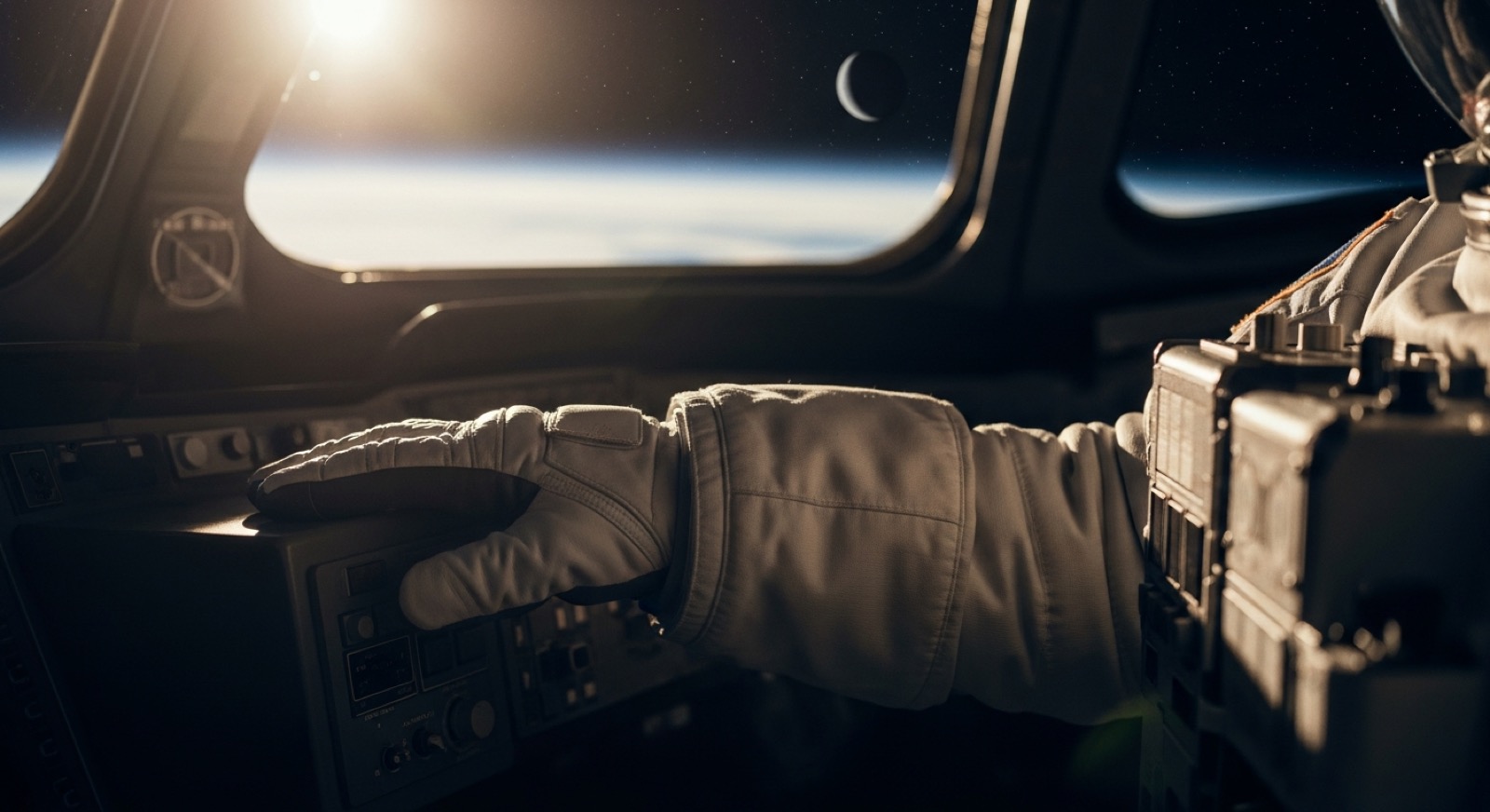
The answer was deliberate restraint. Instead of epic scale, detail. Instead of an orchestral score, silence with precise sonic texture. Instead of technology that shouts, material that whispers. The interior of a capsule. A hand on a control panel. The curvature of Earth through a porthole window.
Luxury does not announce itself. It is recognized.
This comes from something high-end brand work teaches. The same principle applies to AI imagery. When the work does too much, the result signals that it is AI. When you edit with the same restraint you would bring to a 35mm film, it stops signaling.
The method: standard first, edit always
Most AI production makes the same mistake. It opens the model first. We do the opposite. The visual standard is set before anything is generated: palette, light direction, composition, the scale of an object in frame. The tools do not know what is right for the brand. You have to arrive with that resolved.
Generation comes after, as raw material, never as the deliverable. Every camera move was built as a short arc and connected in the edit, because anything longer loses identity. Most of what was generated was thrown away. The coherence did not come from asking the machine for a lot. It came from asking for a little, many times, and discarding what did not serve.
Post-production is where the project stopped being AI output and became a product. The grade, the cut rhythm, the sync with sound, the frame-level timing. None of that comes from a machine. The sound was built deliberately anti-orchestral: tension from layers of texture and structured silence, no conventional score. The sonic build tracks the visual one without announcing it.
Cost and time: the real delta
The first cut was finished nine days after the first generated take: takes began on 24 March 2026 and the master was out on 1 April. What changes is not only the cost of a single shot. It is the speed of conceptual iteration before committing budget to anything physical. You can fail more, test more, and discard more before deciding what makes the final cut.
The part no tutorial shows, in numbers. The project folder holds 113 generated video takes and 180 stills across 13 scenes. The parachute sequence alone took 38 takes, the window shot 20, the reentry 18. And the film at the top of this page is a single continuous shot, without one cut in it. The film is not what the process produced. It is what remained after editing out everything that was too much.
The discipline is in the discard.
The thesis: luxury discipline applied to AI
An eye trained on premium material, the kind that comes from years in luxury production, recognizes when something was made too fast.
Most AI-generated content in 2026 is recognizable as AI not because of how it was made, but because of absent curatorial editing. The machine did everything. Nobody decided what to cut, what was too much, what should not be in frame.
Luxury image production works by subtraction.
You remove until what remains is undeniable. That applies directly to AI: the reel that works is not the one that showed everything possible. It is what remained after discarding what was too much.
What brands can take from this
Define the visual standard before you start. A reference set, a physical moodboard, anything. The machine does not know what is right for your brand. You need to arrive with that resolved.
Separate generation from editing. Generation gives you options. Editing is where the brand exists. Putting raw AI output straight into a feed without a rigorous editorial layer means publishing whatever the average attempt produces, not what the brand represents.
The time saved must be reinvested in curation. AI speed is not for producing more. It is for iterating more before deciding. Using AI to accelerate publishing without accelerating judgment just means publishing more bad work faster.
Portfolio and contact
To see the full CGEYE portfolio or discuss a project: cgeye.tech/contact
Marino Sallowicz is the founder of CGEYE, a hybrid studio of image and technology based in Sao Paulo. He spent more than 12 years working across the world: as Global Image Department Head at Le Creuset he ran studios in France and Thailand and led a global team from Lugano and Barcelona, then worked as a Senior Artist at Bang and Olufsen in Denmark. In those rooms the lesson was constant: material and handcraft precision are the truest signals of luxury.